
Dynamic monitoring systems are an important tool for protecting infrastructure and managing risk in areas subject to seismic activity. The availability of continuous data on the stresses to which structures are subjected makes it possible to observe their actual behavior, identify any anomalies, and support timely, well-documented technical decisions.
In this context, Moni2bsafe has developed a solution based on remotely controlled Wi-Fi accelerometers, designed for real-time dynamic monitoring of structures and infrastructure.
The devices detect the accelerations induced by seismic events or other vibrational stresses and transmit the acquired data to a remote platform, where the information is collected, stored, and processed.
The architecture developed by Moni2bsafe makes it possible to configure the individual accelerometers as independent nodes of a distributed monitoring network.
Each device can be used to monitor a single structure or integrated into a broader network, making it possible to gather information on the behavior of buildings and infrastructure and, more generally, on the stresses recorded during seismic events.
The ability to install and manage the sensors remotely makes this solution particularly valuable even in complex operating environments, where speed of installation, flexibility, and continuity of data transmission play a fundamental role.
| Component | Function |
|---|---|
| Two-way Wi-Fi accelerometers | Detect accelerations and oscillations of the structure when the set thresholds are exceeded. |
| Local network / access point | Ensures the connection between the sensors and the data transmission system, even in complex settings. |
| Moni2bsafe server | Receives, stores, and processes the data acquired by the installed devices. |
| Web interface and reports | Allows the main parameters to be viewed and the production of reports to support technical assessments. |
Application in Turkey after the 2023 earthquake
The earthquake that struck Turkey in 2023 highlighted the importance of having monitoring systems that can be installed quickly and can operate even under difficult conditions.
During a scientific mission carried out in collaboration with the University of Mersin, three remotely controlled two-way Wi-Fi accelerometers were installed, configured as local seismic stations.
One of the devices was installed in a private home in Hatay, one of the areas most affected by the earthquake. To ensure the system’s connectivity, the sensor was paired with a portable Wi-Fi receiver.
The other two accelerometers were installed at the University of Mersin, contributing to the creation of a small local network for acquiring seismic data.
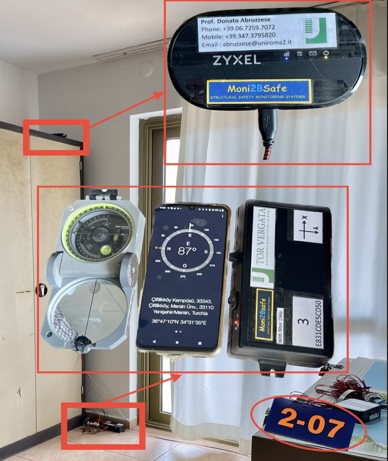
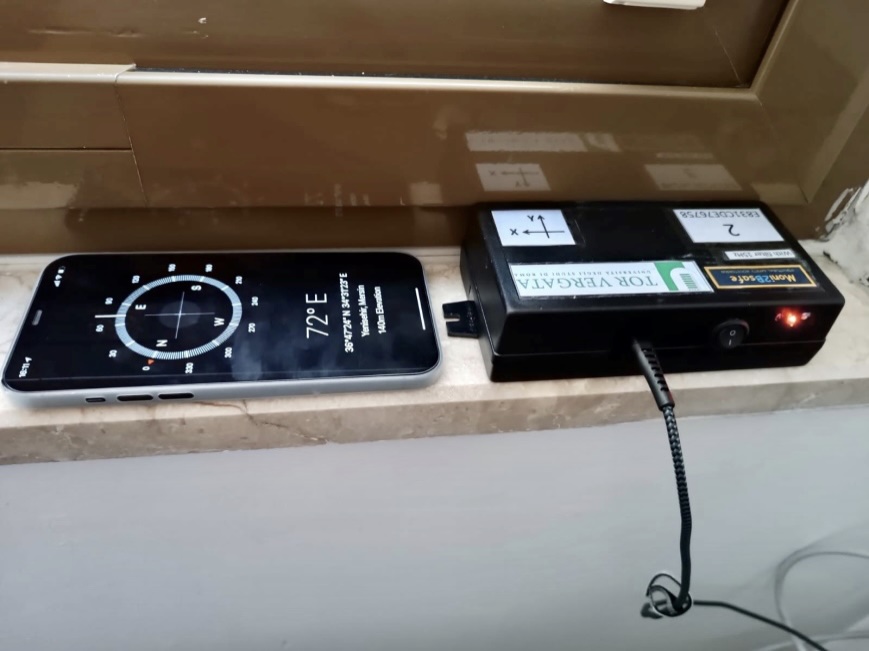
Fig. 1 – Installation of the Wi-Fi accelerometers during the scientific mission in Turkey.
Monitoring in the Phlegraean Fields area
The same technology has been applied to the dynamic monitoring of several structures in the Phlegraean Fields area, a region characterized by seismic activity and bradyseismic phenomena.
The use of a network of Wi-Fi accelerometers makes it possible to acquire information on the dynamic stresses to which the structures are subjected and to track the evolution of events over time.
The availability of instrumental data can give technicians and authorities an additional tool to support risk management, contributing to analysis activities and to the assessment of the condition of structures after an event.
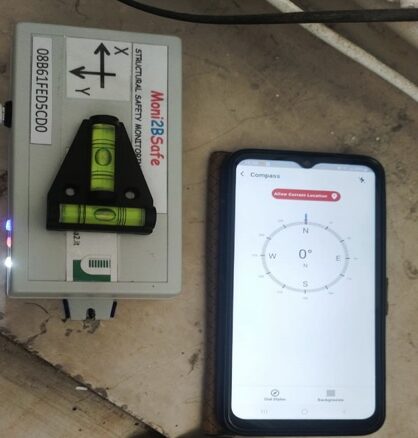
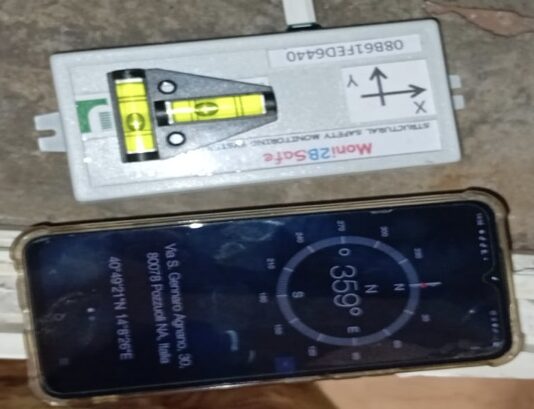
Fig. 2 – Installation of the accelerometers in the Campi Flegrei area.
In both installations, the accelerometers were configured with a threshold-based acquisition mode.
The device remains in monitoring mode and begins recording only when the detected acceleration exceeds a predefined value. Once the threshold is exceeded, the system records the event, transmits the acquired data, and allows it to be saved on the Moni2bsafe servers.
The data is then processed and analyzed, and the main information can be viewed through a dedicated web interface.
This approach makes it possible to optimize data management, reducing the volume of information transmitted and focusing the analysis on genuinely significant events.

Fig. 3 – Recording of the Campi Flegrei seismic event of 13/03/2025 (M = 4.6) with Moni2Bsafe accelerometers.
Continuous monitoring is not only a tool for improving the ability to respond during a seismic event. The systematic collection of data makes it possible to build, over time, a body of information useful for studying the behavior of structures, assessing vulnerability, and carrying out subsequent analysis and design activities.
The system developed by Moni2bsafe combines distributed sensors, wireless transmission, automatic acquisition, and remote data analysis, offering a flexible solution for monitoring structures located in areas of high seismic hazard.
The ability to generate customized reports and to quickly access the key information about an event can also help engineers, facility managers, and authorities identify inspection and intervention priorities, helping to reduce response times and make more effective use of resources.