
The Church of St. Catherine, in Casale Monferrato, is an important example of Piedmont Baroque architecture. Built in the 17th century, it features a spectacular frescoed vault and preserves significant historical and artistic heritage.
The natural deterioration of materials and exposure to changing environmental conditions make continuous monitoring an important tool for protecting the building and preventing potential problems.

Fig 1 — Facade of the Church of St. Catherine, Casale Monferrato.
For the Church of St. Catherine, Moni2BSafe designed and installed a permanent monitoring system, with particular attention to the vault, one of the most delicate elements of the entire complex. The system comprises 10 environmental sensors for the continuous measurement of temperature and relative humidity and 5 threshold accelerometers, used to detect any oscillations or movements of the structure and to promptly flag anomalous variations.
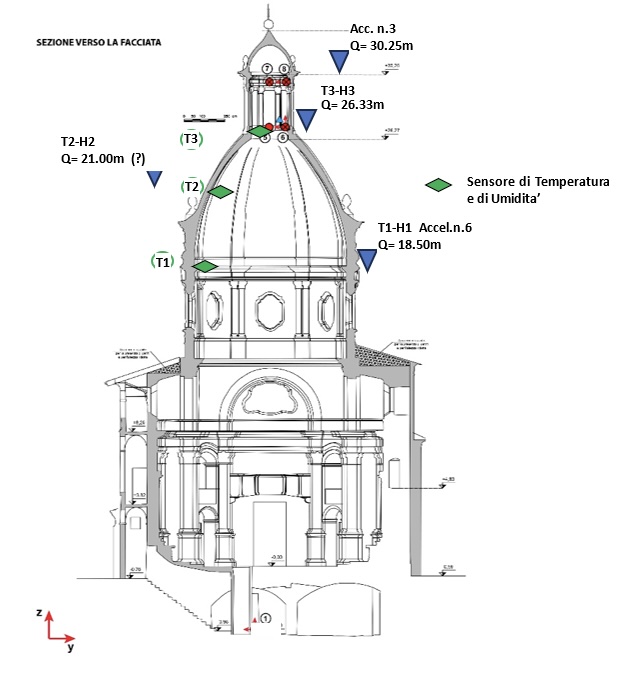
Fig 2 — Diagram of sensor placement inside the church.
Monitoring the environmental parameters makes it possible to track the microclimatic conditions inside the church over time — conditions that are particularly important both for the conservation of the materials and decorative elements and for interpreting how the structure responds to environmental changes.
The position of the sensors inside the church is shown in the following diagram. The T3/H3 temperature–humidity sensor, installed in the highest part of the structure, is located about 26.33 m from the floor. The T2 sensor is placed at an intermediate height on the inner surface of the dome, while T1 is at the height of the drum, about 18.50 m from the floor.
The digital sensors used for temperature operate in the 0–50 °C range, with an accuracy of ±2 °C, while for relative humidity the measurement range is between 20 and 90% RH, with an indicative accuracy of ±5% RH.
Each sensor is connected to a Wi-Fi controller programmed to record temperature and humidity readings every 15 minutes.
The data is transmitted via Wi-Fi to an access point installed about 20–30 meters below and then sent, over a mobile data network, to a remote server dedicated to collecting and storing the measurements.
This architecture makes it possible to monitor the recorded conditions remotely, providing historical data series useful for subsequent analysis and for identifying any changes in the building’s behavior.
During the observation period, recording was interrupted between August 16 and September 9, 2023, due to a lack of power.
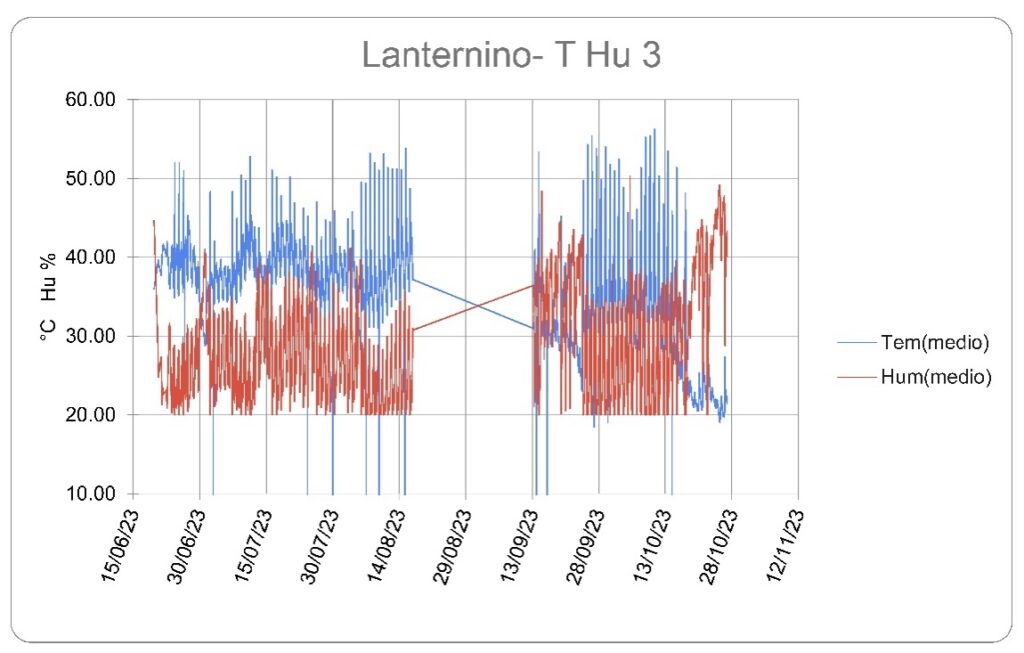
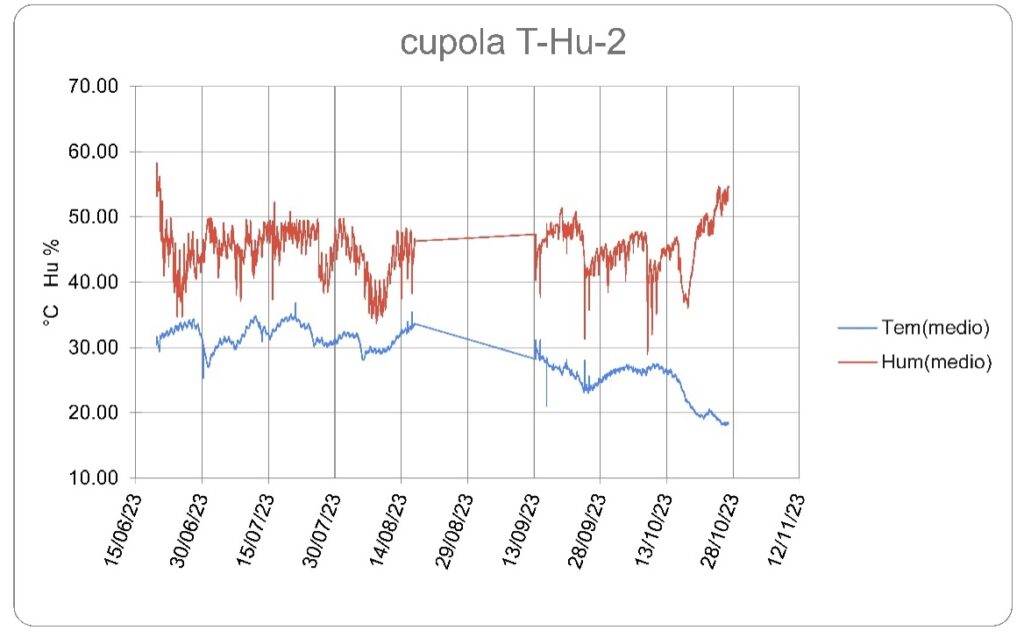
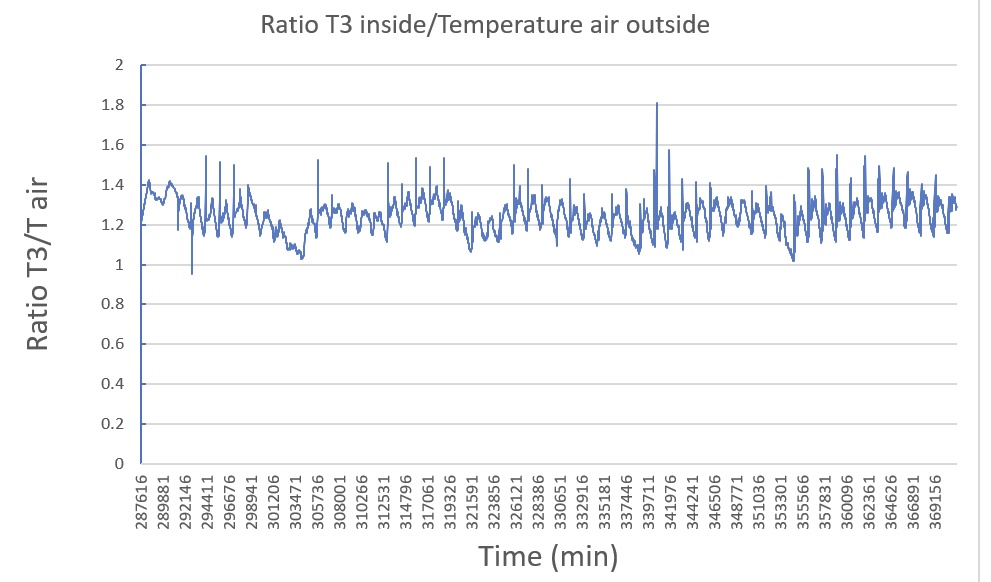
The acquired data made it possible to reconstruct the trend of temperature and humidity inside the church over time, with particular attention to the conditions recorded at height and in the dome area.
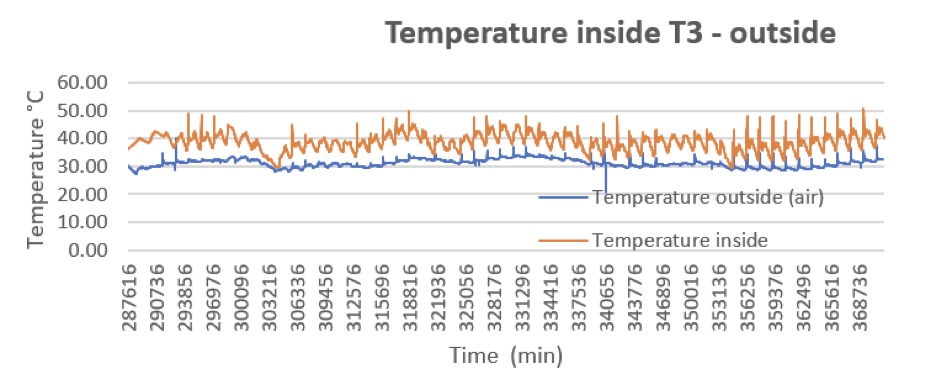
To deepen the analysis, the temperature data recorded inside the building were compared with those from the Casale Monferrato weather station, located at the CREA – Institute for Poplar Cultivation, about 5 km away as the crow flies.
The two data series had different acquisition frequencies: 15 minutes for the sensors installed in the church and 30 minutes for the weather station. It was therefore necessary to realign the measurements to a common time base, so as to obtain a consistent comparison between the data acquired indoors and the external weather conditions.
The processing also took into account the interruptions and discontinuities caused by some uncertainties in the data transmission.
The monitoring of the Church of St. Catherine is an important application of technology to the control and conservation of historical and architectural heritage.
The availability of continuously acquired data makes it possible to follow the evolution of environmental conditions and any dynamic phenomena of the structure, creating a knowledge base useful for assessing the state of the building.
The system therefore serves as a tool to support conservation, planned maintenance, and asset management activities, making it possible to complement traditional inspection activities with continuous, remote instrumental monitoring.