
The Ninfa Garden is a natural monument located in the municipality of Cisterna di Latina. The site is home to an evocative English garden laid out over the area of the ancient medieval town of Ninfa, of which numerous ruins remain today.
During a preliminary inspection, a vertical crack was identified in one of the towers of the complex, in the entrance area, at the upper right of the opening. This crack was selected as a suitable point for a first monitoring trial.
The activity was designed to test the possibility of remotely monitoring, over time, the evolution of a crack in a historic structure, adapting the instrumentation to the specific needs of the setting. Particular attention was paid to protecting the devices, ensuring a continuous power supply, and being able to install the system in a space with tight constraints and limited dimensions. To monitor the crack, two arch extensometers and a digital comparator were installed, the latter used as a reference instrument for measuring displacements. The two extensometers were placed across the crack with different anchoring conditions: one on the mortar and one directly on the tuff blocks. The acquisition system was powered by a 6 V lead-acid battery, housed together with the control unit and the comparator display inside a waterproof box. The container was sealed and positioned in the immediate vicinity of the measurement point, in order to protect the instrumentation from moisture and external agents.
The data was recorded on a micro-SD card every half hour, to be later downloaded and processed at the end of the monitoring campaign.
Inside the tower, the instrumentation was installed directly at the identified crack. Once the operations were complete, the two arch extensometers, the digital comparator, and a hygrometer were in place, connected to the acquisition system.
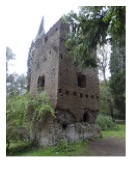
Tower under monitoring.
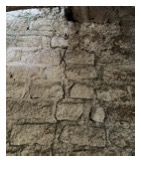
Vertical crack located at the upper right of the entrance.
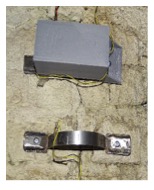
Detail of the Moni2BSafe system installation.
Fig 1 – Overview of the tower, the monitored crack, and the installed system.
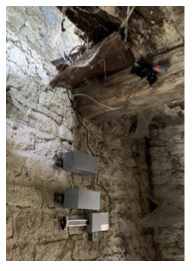
General view of the setup at the crack.
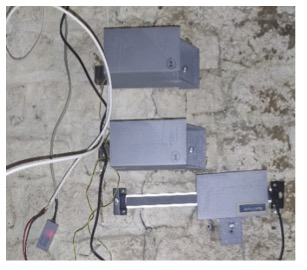
Detail of the complete monitoring system.
Fig 2 – Final configuration of the measurement instruments.
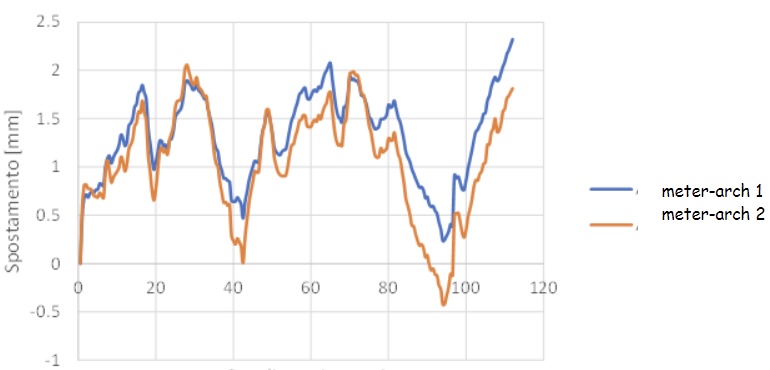
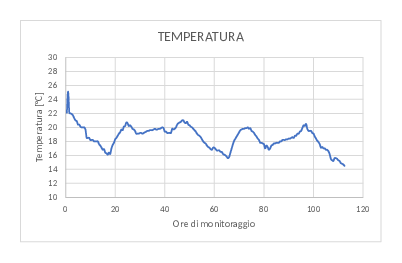
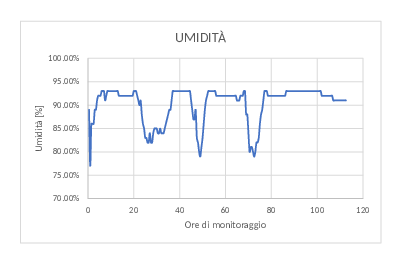
The campaign produced a series of measurements of the crack’s displacements and of the internal environmental conditions, with particular reference to temperature and humidity.
Data was acquired over seven consecutive days, with automatic recording at regular intervals. The curves for the two extensometers showed an overall consistent trend, highlighting the displacement variations recorded during the observation period.
In parallel, monitoring the environmental parameters made it possible to follow the evolution of temperature and humidity inside the tower. This information is an important element for correctly interpreting the variations observed in the masonry and distinguishing, as far as possible, the effects related to environmental conditions from any phenomena of a structural nature.
The trial made it possible to verify the feasibility of a crack-monitoring system applied to a historic structure, in a setting with specific requirements for protection, space, and safeguarding of the instrumentation.
The chosen solution made it possible to start the acquisition campaign while also highlighting some aspects that can be improved. In particular, the size of the protective box made it more difficult to position the system close to the crack. For future applications it will therefore be advisable to develop dedicated supports and more compact enclosures, able to reduce the footprint and simplify installation even in especially confined spaces.
The survey thus represents a prototype for possible future monitoring campaigns within the Park, also in support of future conservation, maintenance, and restoration activities on the ruins.
The experience also confirmed the value of using automatic acquisition systems for the long-term monitoring of cultural heritage, providing an experimental basis for developing solutions that are increasingly simple, compact, and suited to the remote monitoring of historic structures.